A Piano Practice Plan for Age 53
I asked Perplexity Computer to hone my piano practice for my exact age and this was the output and plan.
An addendum specifically for my age: A Piano Practice Plan for the Aging Brain
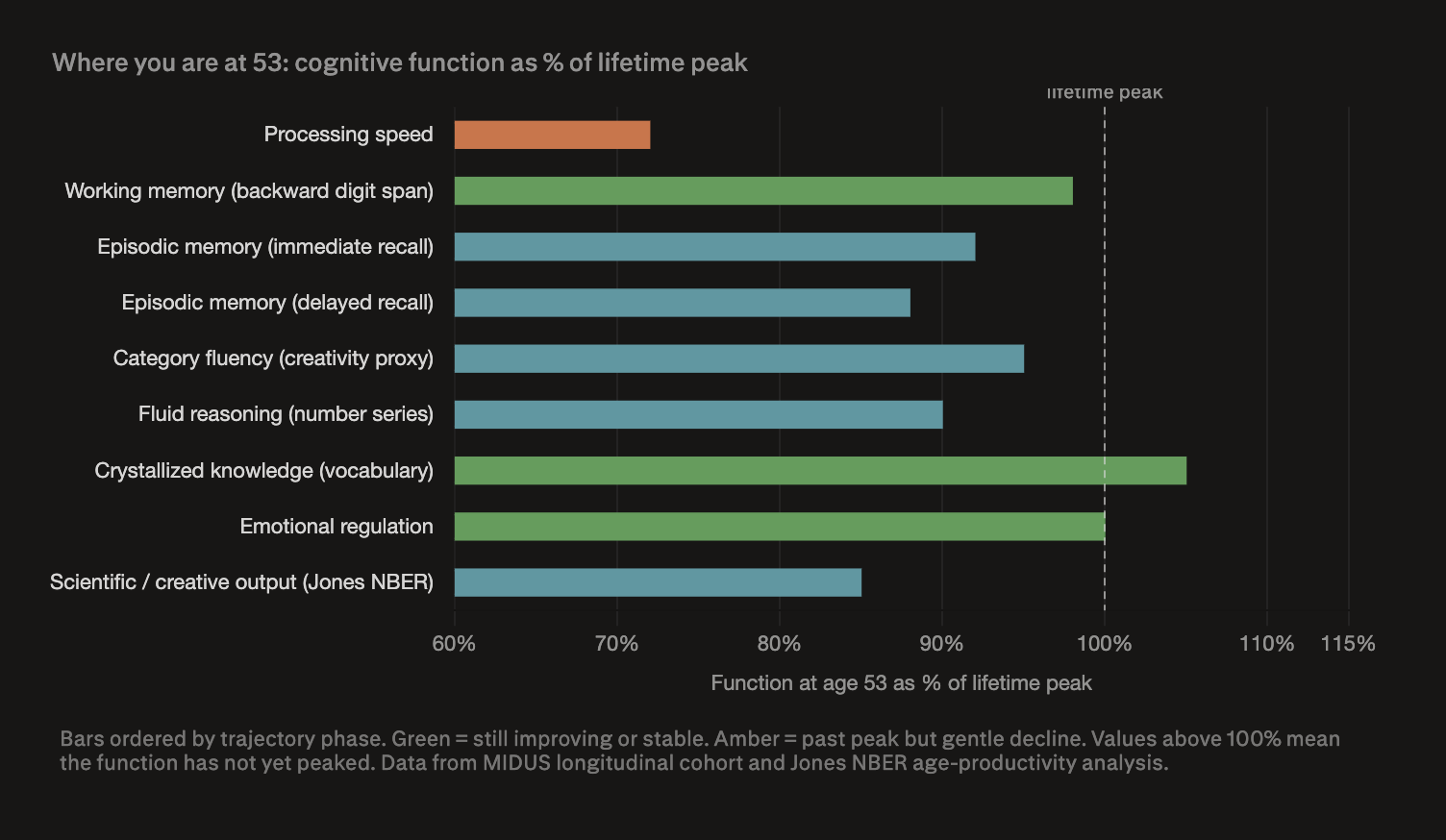
Recalibrated from the generic older-adult plan. The RCT protocols were tested on cohorts aged 62–78 with declining baselines and impaired motor learning. At 53, your working memory is intact, learning speed is near peak, and you're inside the Lancet Commission's highest-leverage midlife window. That changes what the plan optimizes for.
The four structural differences
The generic plan optimized for preservation of function already at risk. Your plan optimizes for capacity expansion during a window when growth is still available, plus targeted defense of the specific domains just starting to erode.
| Dimension | Generic plan (age 62–78) | Age-53 plan |
|---|---|---|
| Primary goal | Preserve fornix, stabilize working memory | Push capacity ceiling higher, defend episodic memory and category fluency |
| Repertoire ceiling | One grade below comfort | At or slightly above technical ceiling |
| Improvisation share | 5 min tail (~12%) | 15–20 min anchor (~35%), 3 days/week |
| Memory work | Implicit via new pieces | Explicit spaced-retrieval protocol |
| Sight-reading share | 5 min (~12%) | 10–15 min (~30%) |
| Session length | 40 min | 50–60 min |
| Weekly rest days | 2 | 1 |
| Cross-domain integration | Optional | Central |
Each shift is anchored to a specific finding from your age-tuned analysis. The rest of this doc walks through them.
Structural difference 1: Repertoire ceiling raised
Why it changes: The TBM trial capped repertoire difficulty because 70-year-old motor cortex learns slowly and mistakes consolidate. At 53 your motor learning speed is closer to your 30-year-old baseline. The novelty-and-challenge signal that drives fornix stabilization and hippocampal encoding is dose-dependent — under-challenging repertoire is neurologically closer to comfort playing.
What changes in the plan:
- Two active learning pieces at your technical ceiling, not one at ceiling and one below.
- Retire pieces from active learning at 6 weeks, not 8. Younger nervous systems consolidate faster and hit the "encoded reflex" state sooner, at which point cognitive value drops.
- Deliberately choose pieces with cognitive load you cannot yet handle — polymetric, atonal, or bimanual-independent (Bach two-part inventions, Schumann, Bartok, Ligeti études). Bach fugues in particular exercise the exact bimanual-independence circuit that TBM measured.
- The "one grade below" sight-reading advice stays — that's a different function. Sight-reading is category fluency training, not motor training.
Structural difference 2: Improvisation as anchor, not tail
Why it changes: The neuroscience of musical creativity is specifically about improvisation, and improvisation trains something the deliberate-practice zone does not — the default-mode-network / executive-control-network switch that underlies divergent thinking and insight problem-solving across all domains. At 70 the DMN-ECN switch is already impaired; the intervention preserves it. At 53 you can still make it faster and more flexible.
What changes in the plan:
Improvisation becomes its own zone with structured constraints, not a "for fun" tail.
The improvisation zone (15–20 min, Mon/Wed/Fri)
Rotate through a 6-week constraint cycle:
| Week | Constraint | What it trains |
|---|---|---|
| 1 | Single mode (Dorian, Mixolydian, Lydian, rotate weekly) | Melodic vocabulary; commit-and-explore |
| 2 | Two-hand ostinato + right-hand melody | Bimanual independence under creative load |
| 3 | Chord-tone soloing over a lead sheet | Harmonic listening; real-time analysis |
| 4 | Free atonal exploration | DMN-ECN switching, evaluation-suspension |
| 5 | Transposition on the fly (learn a melody, play it in all 12 keys) | Executive control under memory load |
| 6 | "Answer" improvisation (record 4 bars, then improvise a 4-bar response) | Musical memory + generative response |
The record-and-listen-back protocol. Record every improvisation session. Listen to it the next morning, not the same day. This uses the same overnight-consolidation principle that spaced retrieval leverages — you're evaluating your own creative output with a fresh executive-control system rather than the one that produced it.
No goal except training the switch. The output does not need to sound good, be shareable, or resemble any style. Judging your improvisation in real time defeats the DMN-ECN training. Judge it 24 hours later.
Structural difference 3: Explicit memory protocol
Why it changes: In the older-adult trials, memory work was implicit — participants learned pieces, and memory gains emerged as a byproduct. That works when the goal is preserving a function already impaired. At 53 the target function (episodic memory) just entered its decline phase — immediate word-list recall began declining in the 40s in MIDUS, delayed recall in the 50s. This is exactly the window where deliberate memory training compounds the strongest.
What changes in the plan:
The spaced-retrieval protocol (daily, 5 min)
- Morning: Learn 4–8 bars of a new piece. Play through it 3–5 times with the score open, then close the score and play it once from memory. Note any errors on paper.
- Same day, no piano contact: Do not revisit this passage during the day. Consolidation is happening.
- Next morning, before opening the score: Attempt to play the same passage from memory. Note errors, then open the score and correct.
- 48 hours later: Attempt again cold. If still solid, retire to a maintenance queue.
- 1 week later: One retrieval attempt. If it survives, it's encoded.
This is Ebbinghaus-style spaced retrieval applied to motor-plus-declarative memory. It's exactly what the "immediate word-list recall" test measures. Doing it daily on musical material is training the underlying circuit.
The memory-piece stack
Maintain a rotating stack of 5–8 pieces played from memory. Cycle through them weekly. Once a piece falls out of the stack for a month, it drops out — you must reencode. The stack size should feel slightly uncomfortable; that's where the training happens.
Structural difference 4: The daily session, restructured
Not four zones of 10 minutes. Five zones, weighted for your goals.
Weekday session (50–60 min)
| Zone | Time | Content |
|---|---|---|
| 1. Bilateral warm-up | 5 min | Hanon or Czerny, hands together, moderate tempo. Rotate keys via circle of fifths. |
| 2. Sight-reading | 10–15 min | Unfamiliar material, one grade below comfort, never repeated. Set a bar target per week (starts around 200 bars/week, increase). |
| 3. Deliberate practice | 15–20 min | One current piece at your technical ceiling. Use one rotating constraint (interpretation, rhythmic displacement, memory chunks, transposition). |
| 4. Memory protocol | 5 min | Spaced-retrieval on the new-material passage from previous days. |
| 5. Improvisation OR expressive | 15–20 min | Mon/Wed/Fri = improvisation zone with weekly constraint. Tue/Thu = expressive playing of the memory-stack pieces. |
Weekly rhythm
| Day | Session |
|---|---|
| Mon | Full session (~55 min); improvisation constraint of the week begins |
| Tue | Full session; expressive/memory-stack focus |
| Wed | Full session; improvisation |
| Thu | Full session; expressive/memory-stack |
| Fri | Performance day: record one piece all the way through + improvisation |
| Sat | Novelty day (30 min): pure sight-reading, unfamiliar composer, one grade above comfort — you're allowed to fail |
| Sun | Rest, or lesson day if working with a teacher |
Six days on, not five. Your consolidation cycle can handle it, and the total dose matters — the RCT dose-response was linear, not diminishing.
Structural difference 5: Cross-domain integration is central, not optional
Why it changes: The Lancet Commission's headline finding for midlife is that integrated cognitive stimulation (particularly at work) produces stronger dementia protection (HR 0.63) than isolated hobbies. The mechanism is that connecting a new skill to existing expertise creates multiple retrieval pathways and deeper encoding.
What changes in the plan: Three concrete integrations you're uniquely positioned to build.
Music theory as a personal knowledge graph
You already build knowledge-management systems and work with graph databases. Music theory is literally a graph structure — chords are nodes, voice-leading transitions are edges, modes are subgraphs, pieces are traversals. Build this in Obsidian or Neo4j:
- Nodes: every piece you've learned, every chord type you've encountered, every key, every composer, every technique
- Edges: "modulates to", "shares motif with", "uses this cadence", "requires this technique"
- Weekly commit: one new piece added with its edges
The graph itself is a memory aid. Retrieving a piece by chord progression, by composer network, by technique family creates multiple pathways to the same motor pattern.
AI-assisted deep learning per piece
Use your AI tools as an analysis partner:
- Have Claude or another model do harmonic analysis of pieces you're learning; ask it to identify the specific technical challenge and design practice exercises
- Compare multiple recorded interpretations of the same piece — what did each pianist choose to emphasize? Why?
- Generate transposition and reharmonization exercises based on the piece's structure
This turns each learning piece into a research project. The Lancet Commission's "cognitive stimulation" is precisely this — sustained, effortful, integrated engagement with novel material.
Teach the 16-year-old, or record explainers
The most consistent finding in the learning-and-plasticity literature is that teaching amplifies encoding. Even if your son doesn't play piano, explaining what you're working on — the piece's structure, why a passage is hard, what you're doing about it — forces you to compress and re-encode. Alternative: record 3-minute video explainers for yourself and rewatch a week later.
What the memory numbers say to prioritize
From the MIDUS data, the specific functions that just entered decline in your decade are:
- Immediate word-list recall (onset: 40s)
- Delayed word-list recall (onset: 50s)
- Category fluency (onset: 50s)
- Number series / fluid reasoning (onset: 50s)
The piano practices in this plan map onto these:
- Spaced-retrieval protocol → immediate + delayed recall
- Sight-reading and improvisation → category fluency (rapid access to musical vocabulary)
- Bach counterpoint, transposition improvisation → fluid reasoning under working-memory load
Optional external tracking every 3 months: digit-span, category fluency (name as many "musical instruments" or "European cities" as you can in 60 seconds), Trail Making A/B. Free apps like Cambridge Brain Sciences cover all of these. If the piano work is doing what the RCT literature says it should, these should hold steady or improve while age-matched averages decline.
The 12-month milestones
Recalibrated from the older-adult trial timelines. At 53 you'll see effects faster.
| Milestone | What to expect | Anchoring evidence |
|---|---|---|
| Month 2 | Motor fluency on new material improving faster than baseline expectation | Age-related motor learning; you're near peak |
| Month 4 | Sight-reading speed measurably improved; improvisation feels less effortful | Category fluency and DMN-ECN switch respond within weeks |
| Month 6 | Memory-stack of 5+ pieces stable; spaced retrieval producing durable encoding | TBM auditory working memory improved at 6 mo (+6.4 pp) |
| Month 9 | Cross-domain graph substantially built; theory-piece connections dense | Consolidation of integrated cognitive stimulation |
| Month 12 | Cognitive function tests holding steady or improving vs. age-matched baseline | Piano RCT executive function SMD 0.43 emerges by year 1 |
| Month 18–24 | Musical ceiling meaningfully higher; creativity in non-music domains observably improved | Improvisation cross-transfer to divergent thinking |
What did not change from the generic plan
Some elements survive the recalibration because they're age-invariant:
- The novelty rule. Repertoire novelty matters at every age. The 15% comfort-piece cap holds.
- The bimanual coupling rule. Never split hands as a default; only for stuck passages.
- The sleep-consolidation rule. Baseline sleep predicts practice gains at every age.
- The exercise-timing rule. BDNF window (60–120 min post-aerobic) is when to schedule new-piece work.
- The record-yourself rule. Friday performance day and the improvisation record-and-listen-back protocol both.
- The continuation rule. Stopping regresses gains at every age. This is not a program you complete.
The one-sentence framing
The generic plan is a preservation protocol; this plan is a capacity-expansion protocol that also happens to be the strongest preservation protocol for the specific functions that just started declining in your decade. The difference is not intensity — it's the ratio of challenge, improvisation, and explicit memory work to comfort and repetition.